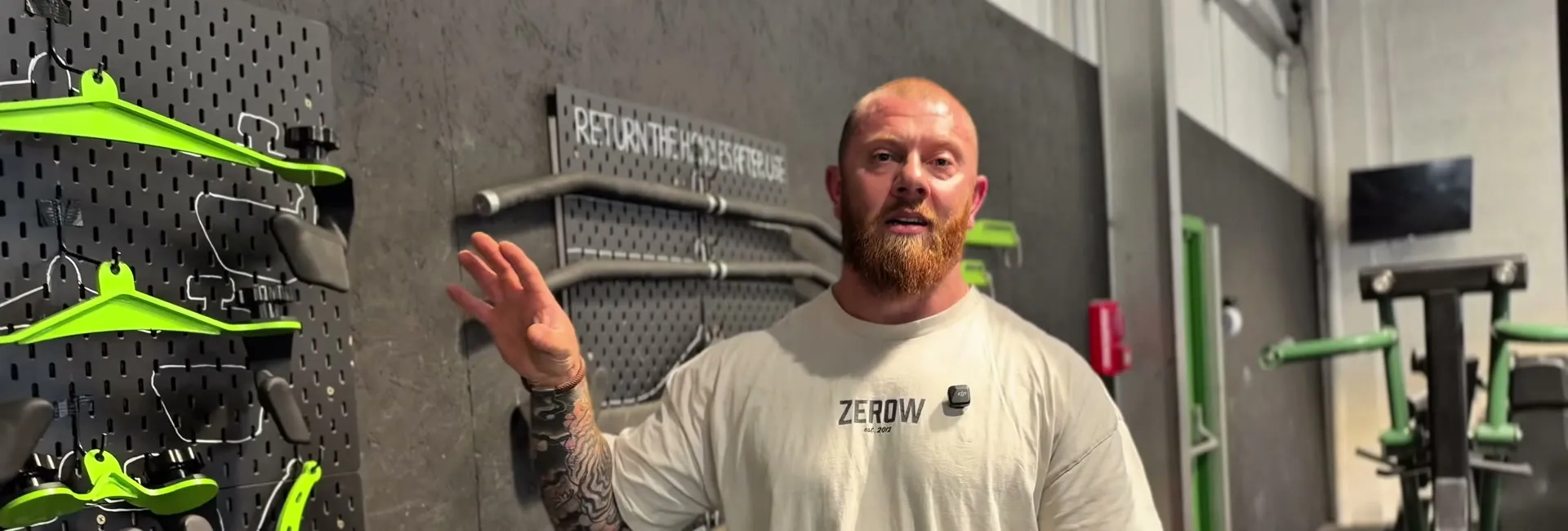
In the third video on the ZeroW YouTube channel, Jordan Helyer takes you round our cable attachment boards. He covers the attachments you'll find in most commercial gyms, a few you probably won't, and why we chose each one.
Wide vs narrow grip attachments
Most gyms have wider and narrower grip attachments for rows and pulldowns. Our adjustable green grips, from Prime, also let you change the angle of your hands: more pronated with your knuckles up, or more neutral and supinated as your palms turn up.
At ZeroW we programme the wider grips more often, because of what they do at the shoulder:
- A wider attachment lets the shoulder travel further into extension, so it's easier to pinch your shoulder blades together.
- That puts the shoulder in a position that's relevant to the low bar squat and the bench press, so the accessory work carries over to the competition lifts.
Narrow grips aren't worse. They take the shoulder through less range and load the back differently.
Our advice: if powerlifting carryover is the priority, lean towards wider attachments. If you're training for body composition and a well-balanced back, use a wide attachment in one session and a narrow one in another each week.
Lat pulldown bars and MAG grips
The traditional lat pulldown bar is ideal for pronated-grip pulldowns. MAG grips work the same pattern with a more neutral or slightly supinated hand position, which changes the angle at the shoulder and hits the lats a little differently.
MAG grips are also kinder on sore wrists. With more padel players and BJJ athletes training at ZeroW, that versatility helps us work around what their sports demand. The same wide-versus-narrow principle applies: narrower grips work the back through less range, wider ones take the shoulders further.
The wrist and forearm attachment
Our newest addition looks more like a knuckle duster than a gym attachment, and it's mainly used for arm wrestling. We added it for the athletes who come to us with banged-up elbows, shoulders and wrists.
It trains rotation of the forearm, pronation and supination, plus radial and ulnar deviation at the wrist. That makes it a versatile way to build health and strength in the lower arm and shoulder, and easy to programme as an isolated exercise.
Angled handles
Fitted to fixed machines such as the high row, angled handles let your hands change position as you pull. Your shoulder can rotate naturally through the movement instead of being locked in one position, which:
- feels better for a lot of people,
- can give a little more range, and
- helps avoid the pinching, impingement-type feeling some people get on fixed handles.
Long triceps ropes
Alongside the standard short ropes, we have long, extendable ropes. They're useful for pullovers, face pulls and Y raises, but Jordan's favourite use is the triceps push-down.
Step back, hinge forward, and push down. Where a normal push-down stops at your sides, the long ropes let you take your hands behind your body. That gives you as much elbow flexion and extension as possible and really loads the long head of the triceps.
Which attachment is best?
None of them. It's about understanding what the exercise is meant to do, then choosing the attachment that complements it. Once you've got that, you'll get far more out of your accessory work.
Want more? Watch the ZeroW gym tour or Jordan's lower body warm-up for squats and deadlifts, and subscribe on YouTube for new videos every week.