In this video, Jordan Helyer, head coach at ZeroW, takes you through the exact lower body warm-up he's using as he preps for his next powerlifting competition. It takes about 10 minutes, and it's built for heavy squats and sumo deadlifts.
Why a warm-up should be individual
The point of a warm-up is to prime your body for the task in front of you. That means it has to fit you. Jordan's warm-up is built around three jobs:
- Access the positions you need for the lift.
- Prime the muscles that hold those positions.
- Build a clear path back into the main lift, so you move well as soon as you're under the bar.
Use what follows as a template, and swap pieces in or out depending on what your body needs.
Movement prep
1. Banded hip stretch
Jordan struggles to open his hips in the squat and sumo deadlift, so he starts with a static stretch. Sitting on a bench, he loops a band over one knee, crosses that leg over, and lets the band draw the knee down and out.
- Hold for 40 to 50 seconds per leg.
- One set if the hips open up, two if they still feel tight.
Static stretching gives a temporary boost in range, which is exactly what he wants before getting into a wide stance.
2. Standing adductor isometric
Jordan has torn both adductors, and the adductor tendon is prone to flaring up under heavy squats and deadlifts. A short isometric primes the tendon before it takes load.
- Anchor a band at the side, step out, and pull it across your body into adduction, using a stick for balance.
- Hold as still as you can for 8 to 10 seconds.
- Two sets: a lighter band first, then a heavier one.
3. Isometric dead bug
This switches on the muscles that hold your brace: the abs and obliques that keep your ribcage down and your torso neutral. It also helps prime the hip flexor and lower ab area, which is useful if you're working around a groin injury.
- Lie with your knees and hips at 90 degrees and pull your ribs down until your lower back is flat on the floor.
- Breathe normally for three or four breaths while holding the position.
- Lower the opposite arm and leg on a small exhale, without your lower back lifting at all.
Be deliberate. The aim is zero change in your lower back position.
4. Leg press for hip stability
The first three drills help you access and hold positions. This one captures the principle Jordan calls torque: stabilising your hips as you move.
- Use a leg press with independent foot plates, set to run as a single-leg press.
- Set your feet in your squat stance and engage your hips.
- Hold that hip position through the full range, all the way down and up.
- Push both plates away together, so your pelvis stays neutral.
You'll probably get more out of this for squats than deadlifts, but it's great for priming the hips either way.
Before squats: face pulls
On a squat day, add two sets of 15 to 20 face pulls just before you get under the bar. The low bar position demands a lot from your upper back and shoulders, and face pulls prime the muscles that hold the bar in place.
Your first warm-up sets
Once the movement prep is done, getting under the bar should feel better straight away. If it doesn't, adjust your warm-up before you load the bar.
Squats. Take your first couple of warm-up sets slowly, using them to feel your position:
- Run through your checkpoints: squeeze your shoulders, set your brace, engage your hips.
- Add a short pause at the bottom and focus on holding your position as you come up.
- There's no need to move your first sets fast. Moving slowly and with purpose is what carries over to your top sets.
If you're a bigger or more advanced lifter, an empty bar may feel awkward until there's some weight on it. That's normal.
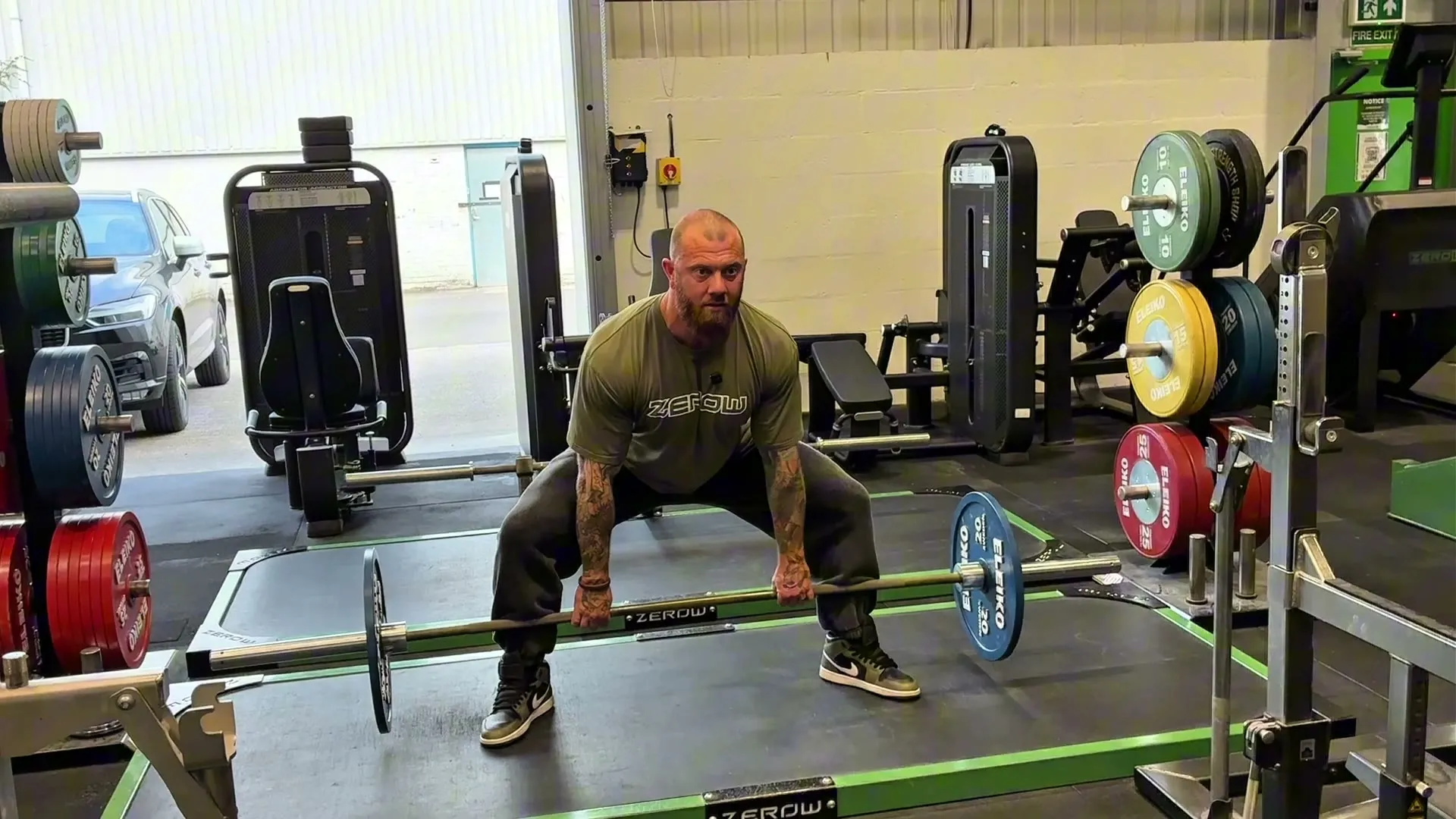
Sumo deadlifts. The sumo hip position is demanding on both flexibility and stability, so Jordan primes it in the lift itself:
- Take the first warm-up weight as a tempo set: three seconds down, touch the floor lightly, three seconds up.
- Do two sets of four to five reps, until your hips feel ready.
- Keep the next three or four warm-ups slow and positional.
- Only on your last one or two warm-ups do you start adding speed and aggression, carrying that positional work into your top set.
The takeaway
This warm-up takes Jordan about 10 minutes. Skip it, and he moves and feels far worse under the bar. Put the effort in, and you'll get much more out of your main work.
Make your warm-up efficient, make it personal, and don't skip it.
Want more like this? Subscribe to ZeroW on YouTube, or read Jordan's article on squat technique and the three biomechanical rules.